
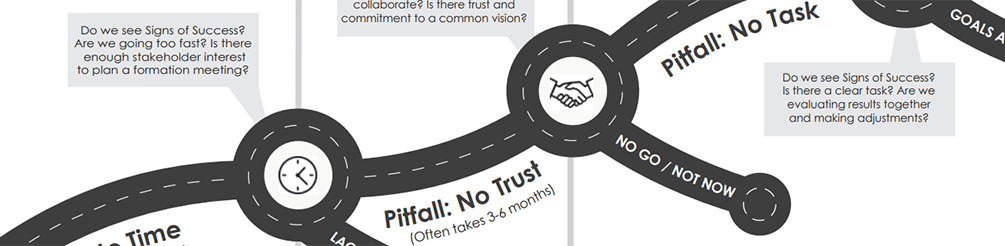
Network Journey Map

Summary

The Network Journey map visually shows the three  stages (Exploration, Formation, Operation) of a network’s development. The Network Journey Map is similar to the Essential Guide to Effective Networks and includes the goals, steps, success factors, and potential pitfalls present in each stage.
The map can be used to explain how networks typically develop. It can also used in a network planning process as you evaluate whether a network is ready to go to the next step.

Key Ideas

  1. The Network Journey map is a visual description of the three different stages (Exploration, Formation, Operation) that we typically see in the development of a network.
  2. The map identifies the goals, activities, signs of success, and major pitfalls that are part of the work required at each stage.
  3. The map shows network development as a linear process. The reality is that networks often revisit different stages during times of change, growth, stress, or transition.
  4. If a network is formed in response to an urgent situation, these stages may take less time, but the work of building relationships, shared understanding, and trust at each stage remains essential. Unresolved issues from a previous stage may need additional attention or need to be revisited.

Citation / Download

  1.  Network Journey Map. Designed by visionSynergy. 2018.
    This map was developed by visionSynergy as a network advising and workshop training tool. It is based on the EFO Network Development Model originally developed by Phill Butler and later refined by visionSynergy in the Essential Guide to Effective Networks.

    It is available in English and five other languages:

Related Articles

Turf, Trust, Co-Creation and Impact

Authentic community change moves at the speed of trust. And yet, we spend so little time and focus on intentionally building trust amongst partners. This paper explores the intricacies of trust, how to build it and what to do when trust is broken.

The Lausanne Cape Town Commitment on Partnership

Paul teaches us that Christian unity is the creation of God, based on our reconciliation with God and with one another. This double reconciliation has been accomplished through the cross. When we live in unity and work in partnership we demonstrate the supernatural, counter-cultural power of the cross. But when we demonstrate our disunity through failure to partner together, we demean our mission and message, and deny the power of the cross.

Trust & Diversity

Ernie Addicott talks about the underlying foundation of effective ministry collaboration – trusting relationships – and demonstrates it is possible not only to work together across denominational boundaries, but to even build real friendships.

The Trinity: A Model for Partnership in Christian Missions

This paper by Enoch Wan and Kevin Penman examines the Holy Trinity as a model for work and relationships in Christian missions today. The paper will begin with an introduction to the doctrine of the Trinity. From there, it will proceed to examine three aspects of the Trinity: the distinct roles of the Three-in-One, how the persons of the Godhead relate to one another, and examples of the One-in-Three working on behalf of mankind. A section on how to apply these truths in the context of Christian missions will be presented. The paper will end with a final conclusion.SOME PRELIMINARY THOUGHTSGod is one! This is the clear cry of the Old Testament. It is found in the Shema, the prayer recited each morning by Jews and taken from Deuteronomy 6:4-6: “Hear, O